
How Long Does
Hazmat Remediation Take?
Most spill cleanups are measured in hours — but the wrong spill on the wrong surface can stretch into months. Here’s what actually drives the timeline, and how Texas law puts a clock on every phase.
North Texas Spill Response | HAZWOPER-Certified | Serving DFW & North Texas
The Short Answer
Most hazmat spill cleanups in Texas are completed in a few hours to a few days. A contained spill on pavement or sealed concrete is often resolved the same day. Spills that soak into soil typically take days to a few weeks because of excavation and confirmation sampling. Spills that reach water or groundwater can take weeks to months — and any cleanup that runs past 180 days moves into a formal, long-term state remediation program with its own multi-year timelines.
“How long will this take?” is usually the second question we hear on an emergency call — right after “how much will it cost?” And the honest answer is that the timeline isn’t determined by how hard the crew works. It’s determined by what spilled, where it landed, and how quickly the response started. Two spills of the exact same material can be a four-hour job or a four-month project depending on those variables.
This guide walks through realistic timelines for common spill scenarios in North Texas, the phases every remediation goes through, and the regulatory deadlines the Texas Commission on Environmental Quality (TCEQ) builds into the process.
Typical Timelines by Spill Scenario
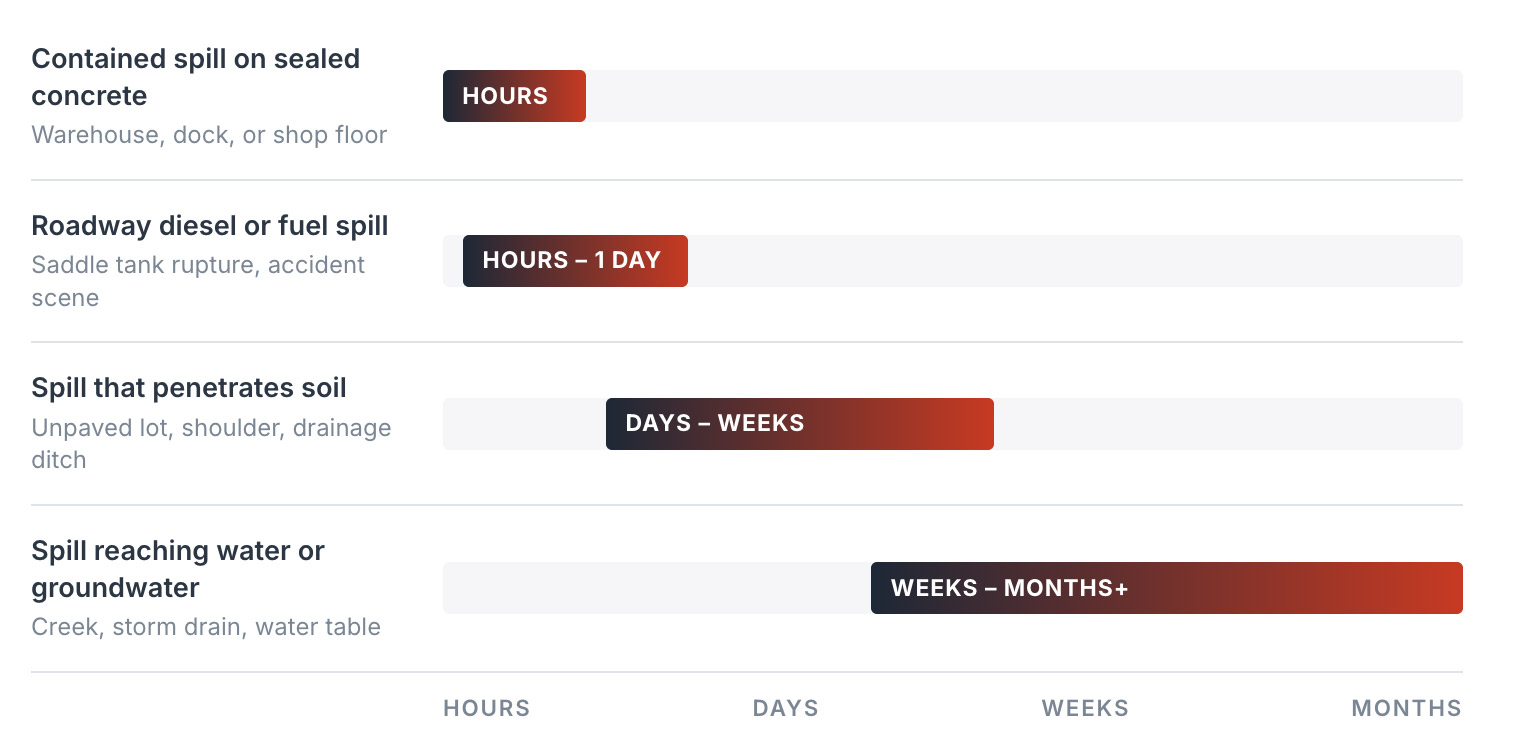
These ranges reflect what facility managers, fleet operators, and insurers should realistically plan for. Every incident is different, but the pattern is consistent: the surface the material lands on matters more than almost anything else.
Contained Spills on Hard Surfaces: Same Day
When a drum tips on a sealed warehouse floor or a forklift punctures a tote on concrete, the material has nowhere to go. Containment, absorption, neutralization if needed, surface decontamination, and waste packaging can usually be completed in a single visit of a few hours. If the spill stayed inside secondary containment, cleanup may be even faster — and depending on the quantity, it may not have been a reportable spill at all.
Roadway Fuel Spills: Several Hours to a Day
A ruptured saddle tank can release 100 to 150 gallons of diesel onto a highway. On intact pavement, an experienced crew can contain, absorb, and clear the scene within hours — which matters enormously to trucking and logistics companies, because every hour a lane is closed compounds the cost of the incident. The timeline extends when fuel runs off the pavement into the shoulder or a drainage ditch, because now you’re not cleaning a road surface — you’re excavating soil.
Soil Contamination: Days to a Few Weeks
Once hazardous material soaks into the ground, the job changes fundamentally. Texas rules require impacted areas to be restored to background — prerelease — conditions, which in practice means excavating contaminated soil, collecting confirmation samples, waiting on laboratory results, and backfilling with clean material. The digging itself may take a day. The lab turnaround, and re-excavating if samples come back dirty, is what stretches soil jobs into weeks.
Water and Groundwater Impacts: Weeks to Months or More
Spills that reach a creek, stock pond, storm drain, or the water table are the long-timeline cases. Contamination moves, which means the affected area has to be delineated before it can be cleaned, and remediation may involve recovery wells, treatment systems, or ongoing monitoring. These are also the cases most likely to cross the 180-day threshold that changes the regulatory framework entirely — more on that below.
⚠ IMPORTANT
Any spill that reaches a waterway — including a dry creek bed or storm drainage channel, which Texas law may classify as a waterway — must be reported regardless of volume. If you’re not certain whether your spill meets an RQ, TCEQ’s guidance is to report it anyway.
The Five Phases of Every Remediation
Whatever the scenario, professional hazmat remediation moves through the same sequence. Understanding the phases explains where the time actually goes — it’s rarely the cleanup itself.
FIRST HOURS
1. Emergency Response & Containment
Stop the release, control ignition sources, deploy booms and absorbents, keep the material out of drains and waterways. Speed here determines everything downstream — a spill stopped on pavement is an hours-long job; the same spill allowed to reach soil is a weeks-long one.
HOURS — DAYS
2. Assessment & Characterization
Identify exactly what spilled, how much, and how far it traveled. For simple spills this happens on scene. For soil or water impacts it may require sampling to delineate the boundaries of contamination before cleanup can even be scoped.
HOURS — WEEKS
3. Removal & Decontamination
Recover free product, absorb residue, excavate impacted soil, decontaminate surfaces and equipment. This is the visible work — and often the shortest phase relative to what surrounds it.
DAYS — WEEKS
4. Verification Sampling
Confirmation samples prove the area meets cleanup standards. Standard laboratory turnaround is measured in days, and rush analysis costs more. If results show remaining contamination, the crew excavates further and samples again — the single most common reason a “one week” job becomes a three-week job.
UP TO 30 DAYS
5. Documentation & Closure
Waste manifests, disposal records, and — for reportable spills — the written follow-up report TCEQ requires within 30 days of the incident. The site may be physically clean in days, while the paperwork closes out over the following weeks.
The Regulatory Clock: Deadlines Texas Builds Into Cleanup
Remediation timelines in Texas aren’t just practical — they’re regulatory. TCEQ’s spill rules in 30 TAC Chapter 327 attach specific deadlines to a reportable spill, and those deadlines shape how the project is managed from the first phone call.
24 hrs
Deadline to report a reportable spill to TCEQ
30 days
Written follow-up report due to TCEQ
6 months
Maximum extension available if cleanup runs long
180 Days
Threshold that moves cleanup into the TRRP program
- 24 hours to report. A spill at or above reportable quantity must be reported to TCEQ as soon as possible and within 24 hours. If you’re not sure whether your spill qualifies — or what happens if you skip the call — we cover that in detail in What Happens If You Don’t Report a Hazmat Spill in Texas?
- 30 days for the follow-up report. TCEQ requires a written report describing the incident and corrective actions within 30 days. If cleanup is still in progress at that point, the responsible party can request an extension of up to six months from the date of the spill, with justification and a projected work schedule.
- 180 days is the line that changes everything. If a cleanup will take more than 180 days, it no longer proceeds under the spill rules. It becomes a project under the Texas Risk Reduction Program (TRRP, 30 TAC Chapter 350) — a formal, risk-based remediation framework involving site investigations, protective concentration levels, and agency-reviewed closure. TRRP projects routinely run for years. Keeping a cleanup under 180 days isn’t just cheaper; it keeps you out of an entirely different regulatory world.
What Makes Remediation Take Longer
Beyond the spill scenario itself, a handful of factors reliably stretch timelines:
Delayed response
Hazardous liquids migrate. Every hour before containment expands the footprint that eventually has to be cleaned, sampled, and documented. The single most controllable factor in remediation duration is how fast the response starts.
The substance itself
Diesel on concrete is straightforward. Corrosives require neutralization before handling. Unknown or mixed materials require identification before anyone can touch them safely — and characterizing an unknown adds time to the front of every other phase.
Weather
Rain during an open excavation can spread contamination and force rework. North Texas storms are a genuine scheduling variable on multi-day soil jobs.
Laboratory turnaround
Confirmation sampling is a hard dependency — you cannot close a soil job without clean results, and standard turnaround is several business days per round.
Waste disposal logistics
Contaminated soil and spent absorbents must be profiled, manifested, and transported to a permitted facility. Disposal facility acceptance can add days to project closeout.
Regulatory involvement
Spills that trigger agency oversight move at the pace of required approvals, not just crew availability.
How to Keep Your Cleanup Short
Most of the difference between a same-day cleanup and a multi-week project is decided in the first hour. Three things keep the timeline — and the cost — down:
Report fast. The 24-hour reporting window exists because early notification gets resources moving while the spill is still small. Reporting promptly also protects you from the penalties that come with staying silent.
Call certified responders immediately — not after a DIY attempt. We’re regularly called to spills where an untrained cleanup attempt spread the material, washed it toward a drain, or generated improperly handled waste. Each of those mistakes adds days and cost to the professional cleanup that follows.
Keep the material off soil and out of water. If there’s one operational priority in the first minutes of any spill, it’s blocking the path to bare ground, storm drains, and waterways. That single intervention is often the difference between an hours job and a months job.